
Volume 102
“How much longer are you going to avoid what you’re capable of doing in order to continue with what you’re comfortable doing?”
We’re halfway through January gang.
We have past Qutter’’s Day - last Friday - where most people make their first departure from their new year’s behaviors.
Motivation starts to wain - the results aren’t coming as quickly as you’d like - and the temptation to just “take a day off” becomes greater and greater.
This inflection point can and will tell the story of your year. The majority will fold and write off this year as another failure, or resolve to restart these goals at a later date.
But those who will succeed will come from two parties - the party who has not given up yet, and the party who faltered but decided to get right back on the wagon. The choice is yours for which group you will identify in. Your future self is watching!
Superset of the Week:
Brain - The Impact of Desired Behavior Groups
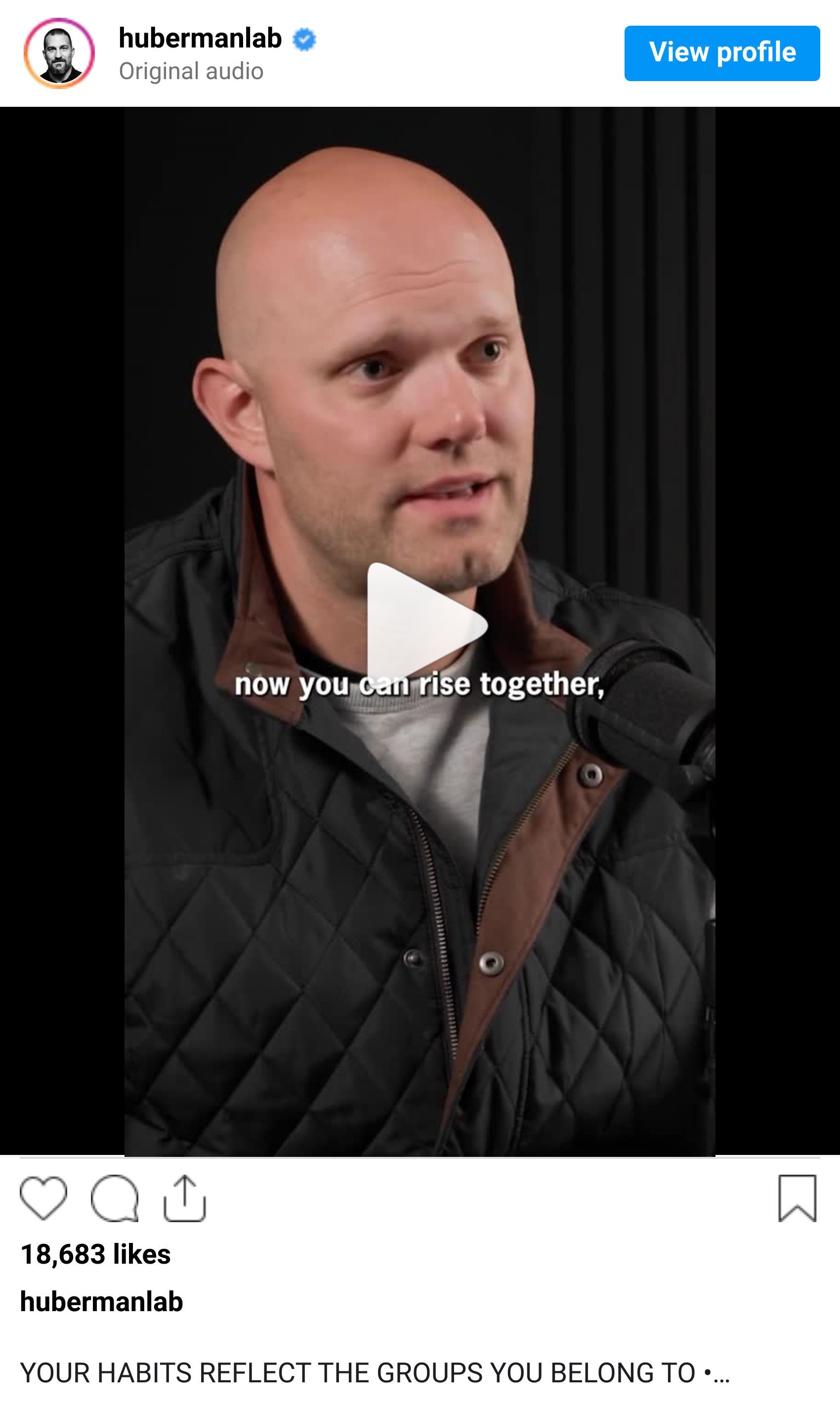
If your environment can make or break a habit, then your social ecosystem - the people you spend time with - can make or break your identity. Andrew Huberman had James Clear on a recent podcast zeroed in on this fact - you don’t just act like the people around you…you become like them.
How Groups Shape Behavior & Identity
At the heart of both Huberman’s neuroscience lens and Clear’s behavioral science is a simple idea - humans are wired to mirror the norms of the groups we belong to. When the behaviors you want become normal in your circle (when they’re the default way people in that group operate) they require less willpower, less effort, and less internal debate to enact.
This isn’t just motivational fluff or the proverbial “you are the sum of the 5 people you spend the most time around.” Social psychology finds that repeated interaction within a group leads to behavioral alignment - opinions, habits, and actions converge through influence (a phenomenon seen in classic social impact theory).
Think of how many examples you’ve (I’ve) seen of this in your own life:
In college you’re surrounded by people whose schedules revolve around going out and drinking - so you find yourself doing the same
You have those two or three career driven friends who you always feel more motivated after hanging around with them
You and your best friend started prioritizing getting in shape together and that constant communication made it easier to stick to
You hang in a circle of like-minded political friends and the general discourse tends to always just agree and group think
James Clear often frames his habit framework around identity-based habits: the real shift isn’t just doing a behavior; it’s becoming the kind of person who naturally does that behavior. So instead of trying to exercise, you belong to groups where “we train” is just normal. That social norm becomes part of your identity.
Huberman reinforces this by pointing out that environments (both physical and social) don’t just trigger behaviors; they reshape neural pathways to make those behaviors more automatic over time.
I would have never gotten in shape if I didn’t have friends around me who were doing it themselves. I would have never ran a marathon if I didn’t have friends join me in the pursuit. I would have never had any career success if I didn’t have a couple of buddies who like to talk business shop when we were together.
The hardest part of this whole thing is that there are likely some ties you need to sever or step away from that are going to be hard to initiate. It’s not easy to step away from people you think you love, but if you conclude it won’t be possible to achieve who you would eventually like to be with them by your side, then it becomes on you to weigh out those pro’s and con’s. What you will likely find in retrospect is that you might have only had that negative behavior / interaction in common in the first place. Here are three actionable moves you can make today:
Audit your circles with a behavior lens.
List the people you interact with weekly. Next to each, write the main habits or priorities they model. Ask: Does this support the identity I want to build?Join or create groups where your desired behavior is the default.
Want to write more? Find or start a weekly writing sprint group. Want to lift consistently? Join a training cohort where attendance is the norm, not the exception. Want to run? Look for a run club or challenge a friend to sign up for a race with you.Make your desired behaviors socially visible.
Host an event or invite accountability partners around a behavior you care about—weekly runs, study sessions, or shared skill practices. When others see it as “normal for you,” your brain internalizes it as part of who you are. Find a person who is training too - text them after every session. It helps, trust me.
These moves turn the passive hope of self-improvement into the active choice of self-selection.
Right now, who is the makeup of your closest circle? If you want to be stronger, more disciplined, or more consistent - do your people naturally reflect those traits, or do you find yourself compensating for them just to stay on track?
Your goals are not just internal battles; they’re socially-contextualized processes. By curating groups where your desired behaviors are normal, you leverage the brain’s social wiring to make your identity inevitable rather than aspirational.
Body - Costco Protein Meal Prep Finds

If you have the pleasure of owning a Costco card, then you own the secret to a fast start on your meal prepping escapade.
Bulk proteins, freezer-ready portions, and pre-cooked shortcuts mean fewer weekday decisions and more high-quality meals. Ask anyone who has spent a lot of time dieting and they will tell you the foundational secret is removing the resistance between you and a high-quality meal. That means:
If you’re short on time usually, get things that are already prepared
If you find yourself on the go, get pre-packaged options
If you find yourself short on protein often, get bulk sources of protein
Don’t rely on yourself to figure things out on the go. After many-a-trips to Costco over the last few years, here are 10 items that consistently end up in my cart - all easy to portion, freeze, or cook. I’ve even shown the cost of every 10g of protein to show this can be budget friendly too.
1. 10-lb Ground Beef Logs
A cult meal-prepping hack in the fitness space. Go back to the deli and ask them for a 10 pound ground beef roll. This off-menu item will come in a tube that you can slice into 1-lb freezer bags → instant bases for chili, tacos, bowls, etc.
Cost / 10 g protein: ~ $0.35 (based on ~$3.20/lb, ~23 g per 4 oz cooked).
2. Kirkland Boneless Skinless Chicken Breasts
A diet can survive without chicken breast, but it’s ranking on the dieting pyramid is a hard one to usurp. These massive packs make it easy to grill, roast, shred, freeze large quantities of the bird.
Cost / 10 g: ~ $0.30–$0.40 (based on ~$3.70/lb).
3. Wild Sockeye Salmon (Frozen Fillets)
Individually wrapped, omega-3 rich, reheats well. These little fillets are a nice way to switch up the flavor pallet when short on time.
Cost / 10 g: ~ $0.65 (based on ~$15/lb, ~22 g per 3 oz).
4. Raw Tail-On Shrimp (Frozen)
These bags from Costco are giant and the shrimp cooks in minutes. A weeknight savior for switching up the evening meal. Just add some protein pasta, rice, and go.
Cost / 10 g: ~ $0.50 (based on ~$13.69/2 lb bag).
5. Rotisserie Chicken
Not a Costco exclusive, but one of my favorites of theirs. No prep required, macro-friendly shortcut. Don’t let anyone tell you rotisserie chicken is bad for your diet.
Cost / 10 g: ~ $0.25–$0.40 depending on yield.
6. Overnight Oats Packets (Kodiak / Mush / Similar)
Breakfast a hard one for you to nail? These are a social meal-prep breakfast staple. Just add some milk, throw it in the fridge, and wake-up to 30g of protein and good balance of cards.
Protein: 30g per pack
Cost / 10 g: ~ $0.80–$1.10 (based on ~$13–$15 multipacks).
7. Grilled Chicken Skewers (Mediterranean-style packs)
These already cooked skewers are a great option. They can be eaten alone, chopped into bowls or wraps, or topped on a salad.
Protein: ~19–20 g per skewer.
Cost / 10 g: ~ $0.70–$0.80 (based on ~$16.99 per pack).
8. Grass-Fed Beef Sirloin Slices (Pre-Sliced)
The “cheat code” protein of Costco Instagram. Cooks fast, easy to portion, great for bowls, tacos, and stir fry. Macro dense and freezer friendly.
Protein: ~21–23 g per 4 oz.
Cost / 10 g: ~ $0.65–$0.75 (based on ~$11–$12/lb multipacks).
9. Chomps Beef Sticks (Costco Multipack)
These are my favorite on the go snack. Clean label, no prep, great for travel or after meetings, and pure protein.
Protein: ~9–10 g per stick.
Cost / 10 g: ~ $1.00–$1.20 (based on ~$24–$26 multipack).
10. Chipotle Chicken Pre-Cooked Bags (Deli Section)
This is a newer Costco cult favorite, but in the meat section, you can find these diced bags of prepped chicken that look like they were prepared in a Chipotle line. Shred and drop into bowls, quesadillas, salads.
Protein: ~22–24 g per 4 oz serving.
Cost / 10 g: ~ $0.55–$0.65 (based on ~$15–$17 bags).
Getting a gram of protein per pound of body weight is a daunting task if you don’t map it out backwards. It’s made even more daunting if you leave it to your will power to continually prep things one meal at a time. That frozen pizza is a lot easier to cook when there isn’t some already cooked protein sitting there for you to grab.
Take advantage of your Costco card and load up on protein this week.
Book - You Still Aren’t Reading More, And You Know You Should

I think most people would like to read more, or at least say they do. Much like people want to be in shape, be successful, eat a nutritious diet, etc. And much like these other ambitions, reading takes time and an incredible amount of friction to get started - but it’s worth it.
Reading isn’t just a hobby for bookish people - it’s one of the most high-ROI activities you can invest in for your brain, career, and mental health. Studies show reading strengthens neural networks involved in focus and comprehension, improving fluid intelligence and long-term cognitive health. Research in Social Science & Medicine found that regular book readers had a 20% lower mortality risk over a 12-year period compared to non-readers. And from a performance standpoint, reading widens your mental models, giving you tools for better decision-making, creativity, and communication. That’s why so many top performers are voracious readers: it’s brain compound interest.
But people often never end up reading much because they don’t approach it with this same universal truth - reading is built like fitness. It’s a training stimulus applied daily, not a once-a-year sprint.
I used to read fewer than five books a year. This year I’m again pushing for 30. The difference is in the systems. Here are some ideas to get started for yourself:
The Reading Plan (Built Like a Fitness Program)
1. Start with Minimum Effective Dose (Weeks 1–4)
Don’t attempt a 300-page novel out of the gate. Like starting cardio with 10-minute walks, you build capacity with small, consistent sessions.
Prescription:
Read 10 minutes per day, no exceptions
Choose books you genuinely want to read (pleasure > prestige)
Use audio + physical book pairing if needed
Goal: Build the identity of “I read every day” not “I finish books.”
Small pages compound. 10 minutes/day = ~600 minutes/month = 1–2 books even for slow readers.
2. Upgrade Your Inputs (Months 2–4)
Reading consistency skyrockets when you enjoy what you read and it rewards you.
Prescription:
Build a 3-category bookshelf:
Entertainment (fiction, memoir, fun reads)
Improvement (skills, psychology, habit, finance)
Utility (books that support your real goals)
Always read at least one entertainment book to keep momentum
Abandon any book you don’t like after 50 pages (no guilt)
Goal: Remove friction + increase dopamine hits from finishing books you enjoy.
3. Layer Intensity & Volume (Months 4–8)
Once the habit sticks, you increase volume, just like adding sets in the gym.
Prescription:
Move to 20–30 minutes per day (same time slot daily)
Add audiobooks during commutes/walks (~3–5 books/year by itself)
Keep 2 books in rotation:
1 easy (entertainment)
1 strategic (career or skill)
Goal: More reading without feeling like “more work.”
4. Track & Compound (Months 8–12)
If you don’t track your lifts, you stall. Same here.
Prescription:
Track books finished (Goodreads or Notion works fine)
Journal 3 bullet takeaways per book
Share recommendations occasionally (reinforces identity)
Goal: Turn reading into a flywheel of identity → competence → consistency.
Challenge for This Week
Pick one book you’re excited to read, set a 10-minute daily reading block, and start today. Don’t worry about finishing, worry about showing up. If you do that for 12 months, you’ll look back shocked at how many books you consumed, because like fitness, consistency beats intensity every time.
Breakthrough of the Week - Habit Tracker
This is one of the simplest forms of tracking from James Clear to utilize for your daily activities that support your developmental goals this year. Print this off and keep it by your nightstand so you can audit your progress each day - Habit Tracker