In partnership with


Volume 105
“Your brain is a piece of software. You update it by reading books, crushing challenges, meditation, learning skills, and your network. Your body is a piece of hardware. You update it through lifting, cardio, nutrition, and stretching” - Dan Go
Most weeks, progress isn’t blocked by a lack of effort. It’s blocked by a lack of structure.
We want to think more clearly, feel better in our bodies, and grow wiser over time, but without the right systems, even the best intentions decay into noise. We avoid failure instead of extracting value from it. We skim information instead of turning it into insight. We underfuel our days and wonder why discipline feels harder than it should.
This week’s issue is about building leverage - mental, physical, and intellectual - by doing a few simple things deliberately and consistently.
You’ll learn:
How to turn failure and disappointment into long-term psychological fuel
How one small nutrition shift can dramatically improve appetite control, energy, and body composition
How to read in a way that compounds wisdom instead of just finishing books
Let’s have a day -
Feel Better, Without Overthinking It

Most of us don’t need a complicated routine. We just want to feel good, stay energized, and not think too hard about it.
AG1 Next Gen is a clinically studied daily health drink that supports gut health, helps fill common nutrient gaps, and supports steady energy. One scoop in cold water replaces a multivitamin, probiotics, and more, so your routine stays simple.
Start your mornings with AG1 and get 3 FREE AG1 Travel Packs, 3 FREE AGZ Travel Packs, and FREE Vitamin D3+K2 in your Welcome Kit with your first subscription.
Superset of the Week:
Brain - The Failure & Disappointment List
The Core Idea
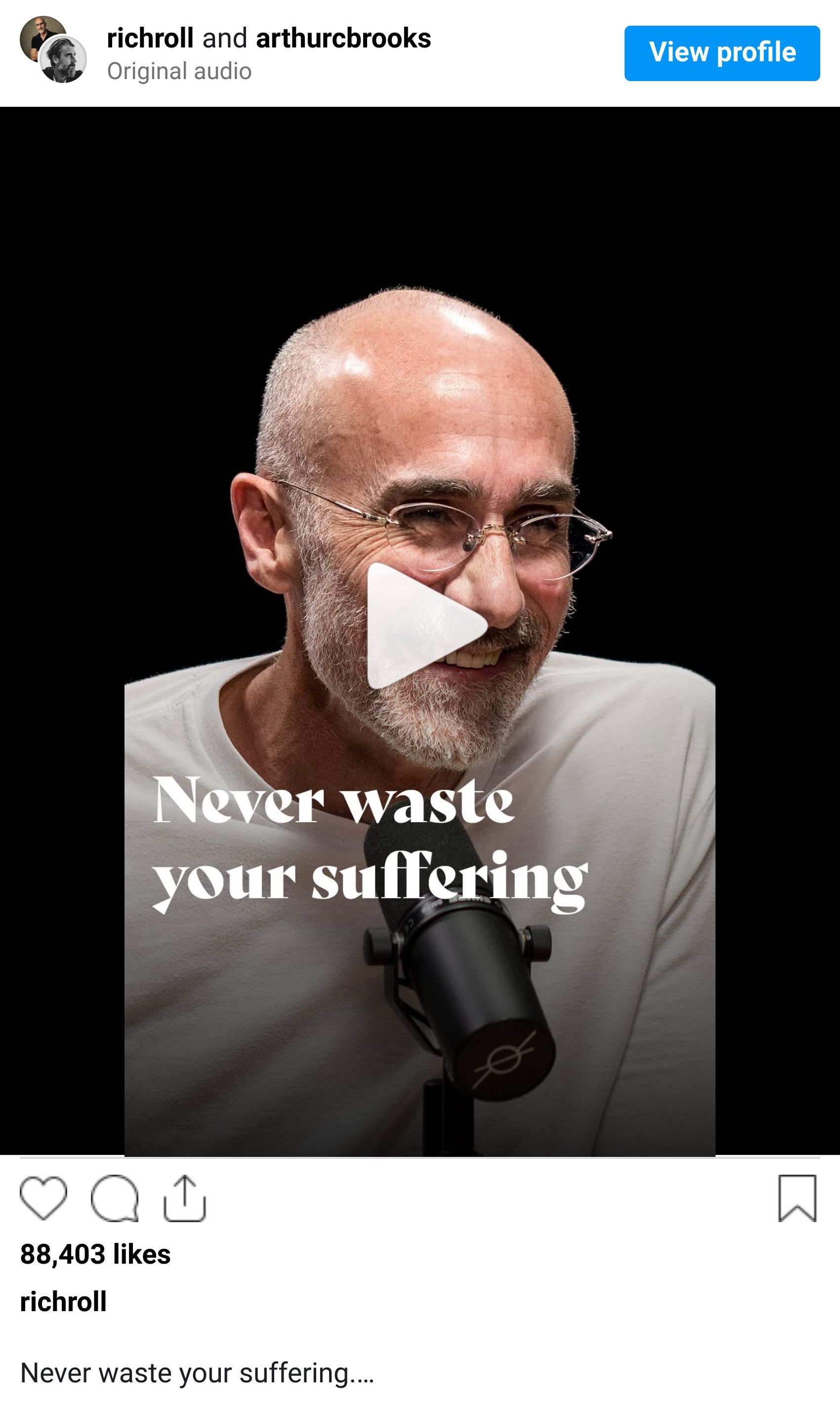
I loved this idea from Rich Roll on a recent podcast this week. So much I am going to immediately put it into action. Most of us treat failure like a hot stove - touch it once, then build our lives around never touching it again. Rich Roll and Arthur Brooks offer a different approach, one that turns disappointment into a long-term asset instead of something to suppress.
The Failure & Disappointment List is simple:
When something goes wrong, you write it down.
You return to it later, twice.
And you force the experience to pay you back with something positive gleamed
As Rich Roll puts it: “Never let your suffering go to waste.” This practice ensures it doesn’t.
Why This Works (Neuroscience Perspective)
Your brain is wired to fear failure because negative experiences activate the amygdala, the threat-detection center responsible for avoidance learning. Left unchecked, this creates a powerful loop:
Pain → Fear → Avoidance → Stagnation
What this protocol does is interrupt that loop over time.
By intentionally revisiting a failure one month and three months later, you engage the prefrontal cortex - the part of the brain responsible for meaning-making, reflection, and long-term planning. Each revisit weakens the emotional charge of the original memory while strengthening a new association: failure → learning → benefit.
Even more powerful is anticipation. Knowing you’ll return to extract value creates what neuroscientists call “predictive reappraisal.” Your brain begins to expect insight on the other side of discomfort. Over time, failure no longer signals “danger”, it signals “future growth.”
That shift fundamentally changes behavior. You take more intelligent risks. You recover faster. You stop running from hard things. In short - you’re not reframing failure after the fact, you’re retraining your nervous system in advance.
This is the deeper point emphasized by Rich Roll and Arthur Brooks is that meaning isn’t found automatically, it’s scheduled.
3. One Action to Take This Week
Start your Failure & Disappointment List today.
Open a notebook (physical works best).
Write one recent failure, loss, or disappointment at the top of a page.
Leave two blank lines underneath.
Put a reminder on your calendar:
30 days → write what you learned
90 days → write something good that happened because of it
That’s it. You’re not trying to feel better right now. You’re training your brain to believe that pain is not the end of the story. And once your brain believes that, fear loses its leverage.
Body - Start Your Day With Protein

The Main Idea: If there’s one nutrition habit that quietly determines how the rest of your day goes, it’s how much protein you eat in the morning. Get this right, and appetite, energy, and body composition all get easier to manage. Miss it, and you spend the rest of the day playing catch-up.
There’s no way to dance around it, as much as you might love a bowl of cereal or a quick meal on the go - morning protein matters, whether your goal is fat loss or muscle gain.
First, protein is the most satiating macronutrient. Starting the day with a high-protein meal reduces hunger hormones and helps stabilize blood sugar, which means fewer cravings and less mindless snacking later. You don’t “white-knuckle” discipline, you biologically need less food.
Second, protein has a higher thermic effect than carbs or fats. Your body burns more calories digesting it, slightly boosting metabolism while supporting lean tissue. That’s a win for both weight loss and weight gain done the right way.
Third, protein early in the day sets the tone for total daily intake. Research consistently shows that people who eat more protein at breakfast end up eating more protein overall, which is critical for preserving muscle during fat loss and building it during growth phases.
3 Actions to Take This Week
1. Anchor breakfast at 30–40g of protein
Eggs with Greek yogurt. A protein smoothie with real food. Leftover meat and rice. Build the meal around protein, not the other way around.
2. Front-load before caffeine
Have protein before or alongside coffee. Caffeine blunts appetite, protein prevents you from accidentally skipping fuel and overeating later.
3. Pre-commit the night before
Decide your protein source tonight. Prep it, portion it, or write it down. Morning decisions are fragile - systems win.
Protein isn’t a hack. It’s a foundation. Build your day on it, and the rest gets easier. What are you going to eat the next four week days to get off to a fast start?
Book - Become a Better Reader With Ryan Holiday’s Framework

You want to read better - you want to read more - yet every time you try, you continue to get slogged down in the same fashion. What can you change to power through this rut, and get to the point where reading feels as natural as brushing your teeth? In comes Ryan Holiday, breaking down an actionable list of things you can do to get better at reading:
1. Quality over Quantity
I’m notoriously bad at this. Reading isn’t a scoreboard. One great book, deeply processed, beats ten skimmed. Read for wisdom, not trivia, or for completion of your new year’s count.
2. Eliminate Friction
Always carry a book (physical or digital).
Read during “dead time”: waiting rooms, flights, lines.
Read while you eat instead of scrolling.
3. Read Actively
Read with a pen. Write in the margins. Argue with the author.
Don’t treat books as sacred objects, treat them as tools.
If a book isn’t delivering value, quit it. (Use the 100 pages minus your age rule.)
4. Build a system, not a streak
Keep a commonplace book: quotes, ideas, stories worth revisiting
Re-read great books. You change, so the book does too.
Follow the “vine-to-vine” method: use footnotes and bibliographies to choose your next read.
5. Expand how you think
Substitute news with history, psychology, and human nature.
Read authors you disagree with - read like a spy, not a fan.
Don’t be a snob. Read bestsellers to understand what resonates.
Reading isn’t about finishing books. It’s about becoming someone who thinks better.
Action for the week: Start small. Carry a book today. Write in it. Read ten pages with intention. Do that consistently, and watch what compounds.
Breakthrough of the Week - The 15 Minute Rule
When motivation is low, lower the entry cost, don’t skip the rep.
The rule: If you don’t feel like training, commit to just 15 minutes.
How to run it today:
Start a timer for 15 minutes
Pick one movement (walk, bike, squat, push-ups)
Stop when the timer ends - no obligation to continue
Most days, momentum carries you past 15 minutes. On bad days, the identity rep still counts.
Action creates motivation (not the other way around)
Consistency is protected
The habit stays unbroken
You don’t need heroic days. You need unskipped ones.